
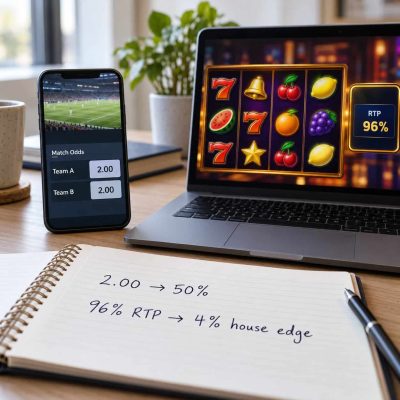
 Sports betting and online slots both involve uncertain outcomes, but they present probability differently. A sportsbook displays prices for particular results, while a slot game combines outcome probabilities with a payout table.
Understanding those differences when exploring a Malaysia slot game or sports betting market helps explain potential returns, bookmaker margins, and what return to player means. It also clarifies why a likely outcome can still lose, and why a large advertised prize says little about how often it occurs. Neither activity offers a dependable way to earn income.
Sports Odds Explain Potential Returns
Decimal odds show the total return for each unit staked on a winning selection. Multiply the stake by the accepted odds to calculate the return, before any applicable deductions. For example, a $10 wager at odds of 2.50 returns $25 if it wins. That amount includes the original $10 stake, leaving $15 profit. If it loses, you lose the stake.
Fractional odds express potential profit relative to the stake. Odds of 3/2 offer $15 profit on a $10 winning wager. American odds express the same pricing differently. Positive odds of +150 indicate $150 profit on $100 staked; negative odds of -200 require $200 staked for $100 profit.
Converting Odds Into Implied Probability
Odds of 2.00 imply 50%. Odds of 4.00 imply 25%. Odds of 1.25 imply 80%. These percentages represent the probabilities associated with the offered prices. They are not independently verified measurements of an outcome’s true likelihood.
For a straightforward wager without fees, the implied probability also identifies the break-even threshold. At odds of 2.00, an actual win probability above 50% would produce a positive mathematical expectation. The difficulty is estimating that actual probability accurately. Confidence, loyalty, and recent results do not establish a reliable estimate.
Bookmaker Margins Affect the Prices
In a market covering all mutually exclusive outcomes, raw implied probabilities often add up to more than 100%. The excess is commonly called the overround. Imagine a two-outcome market offering odds of 1.90 on each side. Each price implies approximately 52.63%, producing a total of 105.26% and an overround of 5.26 percentage points.
That excess reflects a pricing margin. It is not automatically the exact percentage every bettor loses, nor a guarantee of the bookmaker’s realized profit. Sports prices can also change as information arrives. Injuries, scores, and remaining time may affect expectations, while betting demand and exposure can influence pricing.
Online Slots Use Different Mathematics
Online slots generally use random number generation alongside programmed game rules to determine outcomes. The payout table explains what qualifying combinations pay, but does not necessarily reveal their probabilities.
A prize worth 1,000 times the stake isn’t automatically tied to a 1-in-1,000 chance. The game’s mathematical design determines how often that outcome can occur. Likewise, the visible symbols do not necessarily represent equally likely possibilities. Counting images on the screen cannot establish accurate winning probabilities.
Read the game’s information for payouts, bonus conditions, and the stated return to player applicable to the version being offered.
RTP and House Edge Explain Average Returns
Return to player, or RTP, describes the theoretical proportion of total stakes returned as prizes over extensive play. A slot with 96% RTP has a theoretical house edge of 4%. Across $1,000 in total wagers, its mathematical expected return is $960, implying an expected loss of $40.
This concerns total money wagered, including any winnings subsequently staked again. It does not promise that a $100 deposit becomes $96 after a session.
Actual results can differ sharply. RTP also does not mean that 96% of spins win or that an individual player has a 96% chance of making a profit.
Sports probabilities estimate events, whereas slot probabilities come from a defined mathematical model. Both can produce surprising short-term outcomes, but analyzing a team’s tactics does not translate into predicting spins.
Volatility and Independent Outcomes Matter
Two slots can share the same RTP while distributing prizes differently. Volatility describes how widely outcomes vary, including differences in payout sizes and frequency.
In an independent random game with unchanged rules and state, previous losses do not make the next spin more likely to win. Bonus features may change the game state according to published rules.
Understanding probability helps set clearer expectations and make better spending decisions. It cannot remove gambling risk. Set affordable limits, track actual stakes and returns, and avoid treating either sports knowledge or slot statistics as a guarantee.